- Where your data is processed (data zone or single region)
- How you pay (pay-per-token or reserved capacity)
- Performance characteristics (latency variance, throughput limits)
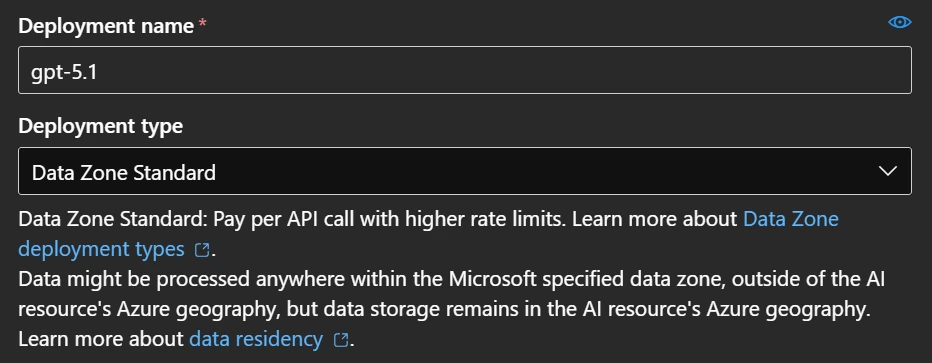
Data residency for all deployment types: Data stored at rest remains in the designated Azure region. However, inferencing data is processed as follows:
- USGov DataZone types: Processed only within the Azure Government cloud USGov data zone
- Standard/Regional types: Processed in the deployment region
Deployment type comparison
| Deployment type | SKU code | Data processing | Billing | Best for |
|---|---|---|---|---|
| Data Zone Standard | DataZoneStandard | Within data zone | Pay-per-token | USGov data zone compliance |
| Data Zone Provisioned | DataZoneProvisionedManaged | Within data zone | Reserved PTU | USGov Data zone + predictable throughput |
| Standard | Standard | Single region | Pay-per-token | Regional compliance, low volume |
| Regional Provisioned | ProvisionedManaged | Single region | Reserved PTU | Regional compliance + throughput |
Not all models support all deployment types. Check Foundry Models sold by Azure for model availability by deployment type and region.
SLA guarantees vary by deployment type. Provisioned types provide guaranteed throughput and lower latency variance. Standard types offer best-effort service. For details, see the Azure SLA for Azure OpenAI Service.
Choose the right deployment type
Use the following criteria to select a deployment type:By data residency requirement
- USGov data zone: Use DataZone Standard or DataZone Provisioned in an Azure Government region
- Single region only: Use Standard or Regional Provisioned
By workload pattern
- Variable, bursty traffic: Use Standard or DataZone (pay-per-token)
- Consistent high volume: Use Provisioned types (reserved capacity)
By latency requirement
- Low latency variance required: Use Provisioned types
- Latency variance acceptable: Use Standard types
Data Zone deployments
For DataZone deployment types, prompts and responses are processed only within the specified data zone:- USGov: Data processed within the two Azure Government regions (USGovArizona or USGovVirginia)
With Data Zone Standard deployment types, if the primary region experiences an interruption in service, all traffic initially routed to this region is affected. To learn more, see the high availability and disaster recovery guide.
Data Zone Standard
- SKU name in code:
DataZoneStandard
Data Zone Provisioned
- SKU name in code:
DataZoneProvisionedManaged
Standard
- SKU name in code:
Standard
Regional Provisioned
- SKU name in code:
ProvisionedManaged
Troubleshooting deployment issues
Common issues when creating or using deployments:| Issue | Cause | Resolution |
|---|---|---|
| Deployment type unavailable | Model doesn’t support the selected type | Check model availability by deployment type |
| Quota exceeded | Subscription limit reached for tokens per minute | Request quota increase at Azure Government AOAI Quota or use a different region |
| Region unavailable | Model not deployed in selected region | Select a region from the model’s availability list |
| Provisioned capacity unavailable | No PTU capacity in region | Try a different region or use DataZone Provisioned for broader availability |
Abuse Monitoring in Azure Government
Not all features of Abuse Monitoring are enabled for Azure OpenAI deployments in Azure Government. You are responsible for implementing reasonable technical and operational measures to detect and mitigate any use of the service in violation of the Product Terms. Automated Content Classification and Filtering remains enabled by default for Azure Government. If modified content filters are required, apply at Azure Government Modified Filter Application.Related content
- Deploy Microsoft Foundry Models in the Foundry portal
- Create and deploy an Azure OpenAI in Microsoft Foundry Models resource
- Foundry Models sold by Azure in Azure Government
- Model region availability by deployment type in Azure Government
- Azure OpenAI in Azure Government quotas and limits
- Provisioned throughput concepts
- Azure OpenAI Service pricing
- Data privacy and security for Foundry Models
- High availability and disaster recovery